
Focused Sámi, Inuit in Greenland, and Arctic guideline subset
For the specific question of research ethics guidelines for working with Sámi and/or Inuit in Greenland, the most directly relevant subset consists of documents 2–6, 8–12, 16 and 17. The subset has varied institutional origins and intended users. It includes a discussion paper on common Sámi guidelines (2); guidance and data governance material developed by the Saami Council (3, 6); a policy brief and Arctic guidance developed through Indigenous and research partnerships (4, 5); a health-research guideline from the Sámi Parliament in Norway (8); SSR policies for research and project collaboration (9, 10); an FPIC procedure from the Sámi Parliament in Finland (11); a guideline for research involving Sámi people in Finland, developed by the working group (12); Inuit Circumpolar Council protocols (16); and a Greenlandic community-based participatory research toolkit developed by authors affiliated with Montana State University and Ilisimatusarfik (17). Appendix A2 identifies the developer or issuer and primary intended recipients of every core source. These documents do not carry equivalent formal authority. They are examined together because each contributes ethical guidance or directly relevant frameworks for research relationships with Sámi and/or Inuit in Greenland Peoples.
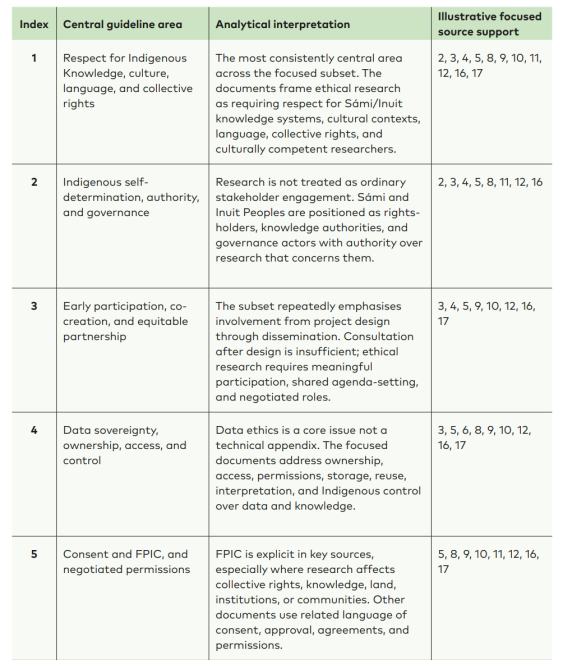
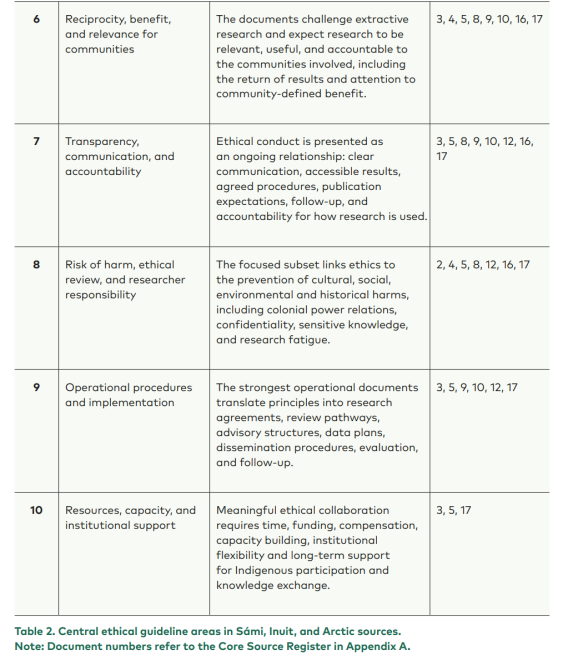
Table 2 identifies ten central ethical guideline areas in the focused subset. It is a qualitative thematic synthesis, based on whether a theme is present and how explicitly it is developed in principles, procedures, or requirements. It is not a word count or a ranking of ethical principles, documents, nations, or regions. The index is used only to identify entries and the source references illustrate where the themes are particularly visible.
4.1. Indigenous Knowledge, culture, and language
The reviewed documents consistently position respect for Indigenous Knowledge, culture, and language as central for ethical research. Indigenous Knowledge is not treated simply as data to be collected, but as knowledge embedded in Indigenous worldviews, languages, cultural practices, and collective responsibilities. Ethical research therefore requires understanding and respect for Indigenous Knowledge systems, cultural heritage, languages, and collective rights while recognising that researchers must possess sufficient cultural competence to engage responsibly with Indigenous communities.
Several of the Sámi and Greenlandic documents place particular emphasis on researchers’ understanding of relevant Indigenous societies, histories, languages, cultural contexts, and knowledge. The discussion paper on Sámi guideline development (2), the Sámi and Arctic ethical guidance (4, 5), the Sámi health research guideline (8), the Ethical Guidelines for Research Involving the Sámi People in Finland (12), and the Greenland Community-Based Participatory Research Toolkit (17) collectively emphasise that research should be grounded in Indigenous Knowledge, cultural contexts, and reciprocal respect.
The international reference documents reinforce these principles through complementary ethical frameworks. The Australian Ethical Conduct in Research with Aboriginal and Torres Strait Islander Peoples and Communities (19) and Te Ara Tika (20) emphasise Indigenous Knowledge systems, cultural values and language as integral to ethical research. International guidance on Indigenous Knowledge governance (1, 22) together with the Tkarihwaié Code (7), the Mi'kmaw Ethics Watch Toolkit (13), the Canadian TCPS2 Chapter 9 (14), and the Circumpolar Inuit Protocols (16) similarly recognise Indigenous Knowledge as collectively held and governed according to Indigenous values, responsibilities, and protocols. The Circumpolar Inuit Protocols (16) articulate this particularly strongly by linking Indigenous Knowledge to Inuit rights, sovereignty, and authority over knowledge.
4.2. Indigenous authority and self-determination
One of the strongest recurring patterns across the reviewed documents is a move beyond research in which Indigenous Peoples are positioned primarily as participants towards approaches that recognise Indigenous involvement, leadership, and authority in research. While the reviewed documents differ in terminology and emphasis, Indigenous Peoples and their communities and institutions are increasingly recognised as rights-holders, knowledge authorities, and actors in research governance rather than as research participants alone.
The Sámi/Arctic documents place particular emphasis on collective rights, participation, Indigenous Knowledge, and Indigenous influence over research. The Ethical Guidelines for Research Involving the Sámi People in Finland (12) explicitly take the Sámi right to self-determination as a starting point and affirm the Sámi right to participate in knowledge production concerning their own society, alongside collective rights, reciprocal communication, and meaningful community involvement. Similarly, the Guidelines for the Saami Council’s Participation in Research Projects (3), the discussion paper on Sámi guideline development (2), the Sámi and Arctic ethical guidance (4, 5), and the FPIC principles of the Sámi Parliament in Finland (11) all recognise the role and authority of Indigenous communities and institutions in research and knowledge production, although they do not all explicitly frame these principles in terms of self-determination or self-governance. The SSR Policy regarding research and project collaboration (9) similarly seeks to strengthen SSR’s role in research conducted in collaboration with the organisation through active participation and influence over the research process.
The sources differ, however, in how far Indigenous authority over research is articulated and operationalised. The Circumpolar Inuit Protocols for Equitable and Ethical Engagement (16) articulate a particularly explicit position, linking Inuit self-determination and sovereignty to Inuit governance structures and decision-making in research and other activities affecting Inuit. Similarly, the Australian Ethical Conduct in Research with Aboriginal and Torres Strait Islander Peoples and Communities (19) emphasises Indigenous leadership and community control, Te Ara Tika (20) highlights Māori authority through partnership and participation, and the Canadian TCPS2 Chapter 9 (14) recognises Indigenous communities as rights-holders and emphasises respect for Indigenous governance.
4.3. Participation, co-creation, and equitable partnership
Across the reviewed documents, meaningful participation is generally understood as involvement throughout the research process rather than consultation after a project has already been designed. Ethical research is expected to involve relevant Indigenous rights-holders, communities, or organisations from the earliest stages of agenda-setting through project design, implementation, interpretation, dissemination, and follow-up. In several of the more participatory frameworks, this extends to shared decision-making in which research priorities, methods, roles, and expected outcomes are negotiated rather than determined solely by researchers.
The Sámi/Arctic documents emphasise early engagement, reciprocal relationships, and collaboration throughout the research process. The Guidelines for the Saami Council’s Participation in Research Projects (3) explicitly state that the Saami Council should be involved from the earliest stages of project design, including the development of research objectives and methods, and that long-term partnerships and adequate resources should support this collaboration. Likewise, the Ethical Guidelines for Research Involving the Sámi People in Finland (12) present reciprocal communication as a core ethical principle, emphasising early dialogue, participation, and trust-based relationships throughout the research process. Ethical Collaborations in Arctic Research (5) reinforces these principles by framing co-creation as an ethical approach throughout the research process. The Greenland Community-Based Participatory Research Toolkit (17) places community engagement, shared decision-making, and partnership at the centre of the research process.
The reviewed documents articulate related approaches to participation through different concepts, practices, and governance arrangements. The Circumpolar Inuit Protocols for Equitable and Ethical Engagement (16) frame participation through the principle Nothing About Us Without Us, calling for Inuit engagement from the outset of any initiative and for meaningful partnerships built on Indigenous leadership, trust, and shared responsibility. Similarly, the Mi'kmaw Ethics Watch Toolkit (13) embeds participation within Indigenous governance through community review and negotiated research relationships. Similarly, the Canadian TCPS2 Chapter 9 (14) and the Māori ethics framework Te Ara Tika (20) emphasise community engagement and participation in research decision-making, although the form and degree of participation differ across these governance traditions.
4.4. Data sovereignty, ownership, access, and control
Data governance is a prominent area across the reviewed material, although the documents differ with regard to whether they explicitly frame it in terms of Indigenous data sovereignty. Examples of other terms used in documents are authority to control, ownership and access to data, collective right to data and research data, governance of information, and Indigenous data rights stewardship. Across the material, data governance extends beyond privacy, confidentiality, and storage to questions of Indigenous authority over areas such as collection, ownership, access, interpretation, reuse, and long-term stewardship of data and knowledge. Several sources therefore frame the governance of Indigenous data as involving collective Indigenous rights and interests alongside individual rights and research ethics requirements.
The Sámi/Arctic documents address these issues through complementary approaches. SODA (6), which builds on the CARE Principles, frames Sámi data governance in terms of Sámi and representative institutional authority to control and administer the data that they have been involved in producing. The Ethical Guidelines for Sámi Health Research (8) explicitly connect Sámi self-determination with collective rights to consent and to control and access data from Sámi health research. The Guidelines for Research and Project Collaborations with Sámiid Riikkasearvi (SSR) (10) operationalise related concerns through agreements addressing the use, future use, access, archiving, and possible withdrawal or destruction of research materials. The Ethical Guidelines for Research Involving the Sámi People in Finland (12) emphasise the ethical management of research materials and respect for collective rights when handling Indigenous research data. The Sámi sources therefore address data governance at different levels: SODA (6) provides an explicit Sámi data governance framework, while documents 8, 10, and 12 address particular collective rights, responsibilities, and procedures concerning research data and materials. The Greenland CBPR Toolkit (17) addresses data governance through community involvement in decisions about data collection, storage, and access particularly through community advisory structures.
The international reference documents further develop these principles. The CARE Principles for Indigenous Data Governance (1) establish Collective Benefit, Authority to Control, Responsibility, and Ethics as the core principles of Indigenous data governance and emphasise Indigenous self-determination, collective rights, and Indigenous authority over the governance and use of Indigenous data. Similarly, the Canadian TCPS2 Chapter 9 (14) and the Australian Ethical Conduct in Research with Aboriginal and Torres Strait Islander Peoples and Communities (19) recognise Indigenous interests in research materials, data management, and ongoing governance of research data. A Guide to Choosing and Using Community-Based Data Management Systems for Indigenous Land-Based Programs (22) complements these principles by providing practical guidance for establishing Indigenous data governance, emphasising governance structures, community decision-making, Indigenous data sovereignty, and the application of frameworks such as CARE and Ownership, Control, Access and Possession (OCAP) in community-based data management systems.
4.5. Consent and FPIC
Although consent and related approval processes are addressed across much of the reviewed material, their terminology, scope, and institutional form differ. While some documents explicitly refer to Free, Prior and Informed Consent (FPIC), others emphasise consent, approval, negotiated agreements, community engagement, or community review. Several of the stronger governance-oriented frameworks treat consent and related approval processes as continuing relationships that may require dialogue, review, or renewed agreement as research develops rather than as a single procedural requirement.
The Sámi/Arctic documents demonstrate different approaches to consent and FPIC. The Ethical Guidelines for Research Involving the Sámi People in Finland (12) explicitly recognise FPIC as a fundamental ethical principle and distinguish collective FPIC from the individual consent that must be obtained from research participants. The Procedure for Seeking the Free, Prior and Informed Consent of the Sámi (11) provides an operational framework for seeking FPIC, including procedures for information-sharing, consultation, and Sámi decision-making. The Guidelines for Research and Project Collaborations with Sámiid Riikkasearvi (SSR) (10) state that an FPIC agreement should be drawn up between the relevant parties where SSR decides to participate in a research project. The agreement addresses roles and responsibilities, methods, data management, expected effects and benefits, feedback, and conditions for withdrawal from the collaboration. Ethical Collaborations in Arctic Research (5) also identifies FPIC as a foundation of ethical research while placing it within broader trust-based relationships, community protocols, and continuing dialogue. The Circumpolar Inuit Protocols for Equitable and Ethical Engagement (16) similarly situate consent within Inuit governance and decision-making, including Inuit authority to determine whether and under what conditions engagement proceeds.
The international reference documents provide related consent, approval, and engagement models. The Tkarihwaié Code of Ethical Conduct (7) identifies prior informed consent and/or approval and involvement as a core ethical principle and states that consent should be free from coercion while being based on transparency and full disclosure. The Circumpolar Inuit Protocols for Equitable and Ethical Engagement (16) embed consent within Inuit governance and decision-making processes, while the Australian Ethical Conduct in Research with Aboriginal and Torres Strait Islander Peoples and Communities (19) links consent to Indigenous leadership and negotiated research relationships. Although the Canadian TCPS2 Chapter 9 (14) and the Guidebook for Research with Nunavut Communities (15) further reinforce the importance of community engagement, prior consultation, and community approval, they use different terminology and place varying emphasis on FPIC itself.
4.6. Reciprocity, benefit, and relevance for communities
Across the reviewed material, reciprocity is closely connected to the expectation that research should be relevant to Indigenous priorities and produce benefits that are meaningful to the Indigenous Peoples, communities, or organisations concerned. Research is expected to avoid extractive approaches that primarily benefit researchers or institutions. Ethical research is therefore associated with reciprocal relationships, shared responsibilities and benefits that respond to Indigenous priorities and are defined with or, where appropriate, by the Indigenous Peoples concerned.
Several of the Sámi, Greenlandic, and Arctic documents translate reciprocity and benefit into practical expectations concerning research relationships, relevance, and return. Ethical Collaborations in Arctic Research (5) promotes trust-based collaboration and reciprocal relationships. The SSR guidelines (10) operationalise reciprocity through negotiated agreements addressing responsibilities, expected effects and benefits, communication, feedback, and the return of results. The Sámi health research guideline (8) emphasises reciprocity and the importance of research being relevant and beneficial to Sámi communities. Roadmap to Decolonial Arctic Research (4) argues for moving beyond extractive research towards equitable partnerships, co-creation, and research responsive to Indigenous priorities. The Greenland CBPR Toolkit (17) operationalises reciprocity through long-term relationship-building, capacity-building, and an emphasis on research that produces tangible community benefits and strengthens local decision-making. The Circumpolar Inuit Protocols (16) connect reciprocity to equitable engagement, accountability, and meaningful relationships grounded in Inuit priorities and leadership.
The international reference documents reinforce these principles through complementary frameworks. The Canadian TCPS2 Chapter 9 (14) connects participatory research with respect, relevance, reciprocity and mutual responsibility, and emphasises research relevance and community benefit. The Australian Ethical Conduct in Research with Aboriginal and Torres Strait Islander Peoples and Communities (19) identifies reciprocity as a core ethical value and explicitly recognises the right of Indigenous communities to define benefits according to their own values and priorities. Te Ara Tika (20) similarly connects ethical research with relationships, reciprocity, justice, and benefit.
4.7. Transparency, communication, and (relational) accountability
Transparency, communication, and accountability emerge as continuing responsibilities throughout the research process. These responsibilities include clear communication about research aims, methods and expectations, continuing dialogue with Indigenous partners, accessible communication of findings, and accountability for research commitments and the use of research results and materials.
The Sámi, Inuit in Greenland, and Arctic documents address these responsibilities through reciprocal communication, agreed procedures, and continuing research relationships. The Ethical Guidelines for Research Involving the Sámi People in Finland (12) identify reciprocal communication as a core ethical principle and emphasise continuous dialogue, openness, and mutual understanding. The SSR guidelines (10) operationalise transparency and accountability through written agreements addressing responsibilities, communication, feedback, use of research materials, and the return of results. The Sámi health research guideline (8) similarly emphasises communication, dissemination of findings, and researcher responsibility. Ethical Collaborations in Arctic Research (5) promotes transparency and accountability within collaborative research relationships. The Circumpolar Inuit Protocols (16) connect transparency directly to good governance, defining it through openness, communication, and accountability.
The international reference documents reinforce these principles through different ethical and governance frameworks. The Mi'kmaw Ethics Watch Toolkit (13) links accountability to continuing relationships and communication with Mi'kmaw communities. The Canadian TCPS2 Chapter 9 (14) emphasises transparency, collaborative decision-making, and continuing accountability in respect of participating communities. The Australian Ethical Conduct in Research with Aboriginal and Torres Strait Islander Peoples and Communities (19) highlights transparency, honesty, and accountability within ethical research relationships. Te Ara Tika (20) similarly connects ethical research relationships with transparency, good faith, and continuing Māori involvement in governance and monitoring.
4.8. Risk of harm and researcher responsibility
The prevention of harm and recognition of researcher responsibility are recurring concerns in the reviewed material. Taken together, the documents identify multiple forms of potential harm including cultural, social and environmental harm, inappropriate use of Indigenous Knowledge, unequal power relations, and risks associated with sensitive research contexts. Ethical responsibility therefore extends beyond compliance with formal ethics procedures to include continuous reflection on the consequences of research for Indigenous Peoples.
The Sámi, Inuit in Greenland, and Arctic documents address these concerns through different forms of researcher responsibility and ethical reflexivity. The Ethical Guidelines for Research Involving the Sámi People in Finland (12) address these issues through Guorahallan ja vihkkedallan (reflection and critical self-reflection) requiring researchers to consider their positionality, assess potential harms and risks, and reflect on the wider consequences of their research for Sámi society and communities. The Sámi health research guideline (8) similarly emphasises the identification and minimisation of potential harms and the protection of participants and communities. Ethical Collaborations in Arctic Research (5) and Roadmap to Decolonial Arctic Research (4) further connect ethical responsibility with the recognition of colonial research legacies, avoidance of extractive practices, and critical attention to unequal research relationships. The Circumpolar Inuit Protocols (16) approach researcher responsibility primarily through accountability to Inuit rights, governance, and knowledge systems.
The international reference documents reinforce these concerns through complementary ethical frameworks. The Mi'kmaw Ethics Watch Toolkit (13) and Canadian TCPS2 Chapter 9 (14) address ongoing ethical responsibility, community protection, and the identification and minimisation of research risks. The Australian Ethical Conduct in Research with Aboriginal and Torres Strait Islander Peoples and Communities (19) explicitly requires researchers to minimise harm, assess risk, and maintain accountability to individuals and communities. Te Ara Tika (20) similarly incorporates consideration of risks, benefits, potential negative outcomes, and researcher accountability into ethical assessment.
4.9. Operational procedures and implementation
A number of the reviewed frameworks translate ethical principles into practical procedures for establishing, governing, and following up research relationships. These include research agreements, consent and approval processes, data management arrangements, communication and dissemination plans, community or Indigenous review, allocation of responsibilities, and procedures for evaluation and follow-up. Although the degree of operationalisation varies across the documents, the more procedural frameworks make explicit how broader principles such as self-determination, reciprocity, and accountability can be translated into research practice.
The Sámi, Greenlandic, and Arctic documents provide different models of operationalisation. The Guidelines for the Saami Council’s Participation in Research Projects (3) operationalise collaboration through early involvement, formal agreements, defined responsibilities, communication and dissemination arrangements, resourcing, and follow-up. Ethical Collaborations in Arctic Research (5) encourages project-specific ethical agreements and jointly negotiated expectations while deliberately avoiding a single procedural model. SODA (6) provides a more specialised form of operationalisation by translating Indigenous data governance principles into expectations concerning Sámi authority over the control and administration of data. The SSR guidelines (10) provide another concrete model by using negotiated FPIC agreements to specify responsibilities, research arrangements, data-related issues, feedback, and conditions for collaboration. The Ethical Guidelines for Research Involving the Sámi People in Finland (12) connect ethical principles with practical responsibilities throughout the research process while retaining a reflective rather than prescriptive approach. The Greenland CBPR Toolkit (17) is one of the most detailed sources for implementing collaborative research across the research process, including partnership development, community advisory structures, shared decision-making, dissemination, evaluation, and follow-up.
Several international reference frameworks provide more formalised models for translating ethical principles into research procedures. The Mi'kmaw Ethics Watch Toolkit (13) provides a distinct Indigenous community-based ethics review mechanism, while the Canadian TCPS2 Chapter 9 (14) formalises community engagement, research agreements, and the relationship between community processes and institutional ethics review. The Australian guidelines (19) translate core ethical values into practical expectations for research relationships, benefit, and community engagement, while Te Ara Tika (20) structures ethical assessment through minimum standards, good practice and best practice concerning Māori engagement, governance, benefit, and monitoring. The Guidebook for Research with Nunavut Communities (15) complements these approaches with practical community-oriented guidance on engagement, communication, dissemination, and benefit.
4.10. Resources, capacity, and institutional support
In several documents adequate resources, capacity, and institutional support emerge as necessary conditions for implementing ethical research in practice. These conditions include sufficient funding and time, long-term partnerships, Indigenous research capacity, appropriate compensation, and institutional commitment. Rather than locating responsibility solely with individual researchers, several documents emphasise that research institutions, funders, and Indigenous organisations also have responsibilities for creating the conditions necessary for ethical research.
The Sámi, Inuit in Greenland, and Arctic documents address these conditions at both the project and structural levels. The Guidelines for the Saami Council’s Participation in Research Projects (3) emphasise that meaningful participation requires adequate financial resources, sufficient time for collaboration, and long-term commitment from participating organisations. Similarly, Ethical Collaborations in Arctic Research (5) highlights sustained investment in relationship-building, institutional flexibility, and support for long-term partnerships. The Roadmap to Decolonial Arctic Research (4) places these responsibilities at a more structural level, calling for reform of research funding structures, remunerated Indigenous participation in decision-making, support for Indigenous scholars and research networks, and long-term capacity building within both Indigenous and research institutions. The Greenland CBPR Toolkit (17) emphasises capacity building through training, local research employment, shared learning, and strengthening of community research capacity. The Circumpolar Inuit Protocols (16) make resourcing an explicit ethical requirement through the principle of equitably funding Inuit representation and knowledge, including appropriate compensation, local hiring, support for Inuit organisations, and Inuit authority in determining funding needs and allocation. International reference documents reinforce the importance of institutional and material support for ethical research. The Australian Ethical Conduct in Research with Aboriginal and Torres Strait Islander Peoples and Communities (19) addresses capacity strengthening and institutional commitment to equitable research relationships, while Te Ara Tika (20) recognises institutional support for Māori participation and governance. Similarly, the Guidebook for Research with Nunavut Communities (15) addresses time, resources, and local capacity development as conditions for sustainable research relationships.