
The comparative findings in Section 3 identify the most prominent ethical guideline areas within the focused Sámi, Inuit in Greenland, and Arctic subset. Building on these findings, the trend analysis examines how these themes are developing across the full corpus of 22 reviewed documents and identifies broader developments that may be relevant for future Sámi, Greenlandic, and Arctic guideline development. The trends are analytical patterns rather than simple summaries of the thematic findings. They are not equally prominent in every document and the term does not claim a uniform chronological progression: the sources span 2011 to 2025 and the review did not undertake a time-series analysis. In this report, emerging trends are thematic developments particularly visible in selected operational or relatively recent sources. Table 3 identifies illustrative source support for each finding, while Appendix A permits readers to verify each source’s year, developer or issuer, intended recipients, and analytical role. The table should therefore be read as traceable qualitative synthesis, not as evidence of a linear development from older to newer documents.
Table 3 summarises the primary cross-cutting trends identified across the full corpus and their implications for future guideline development.
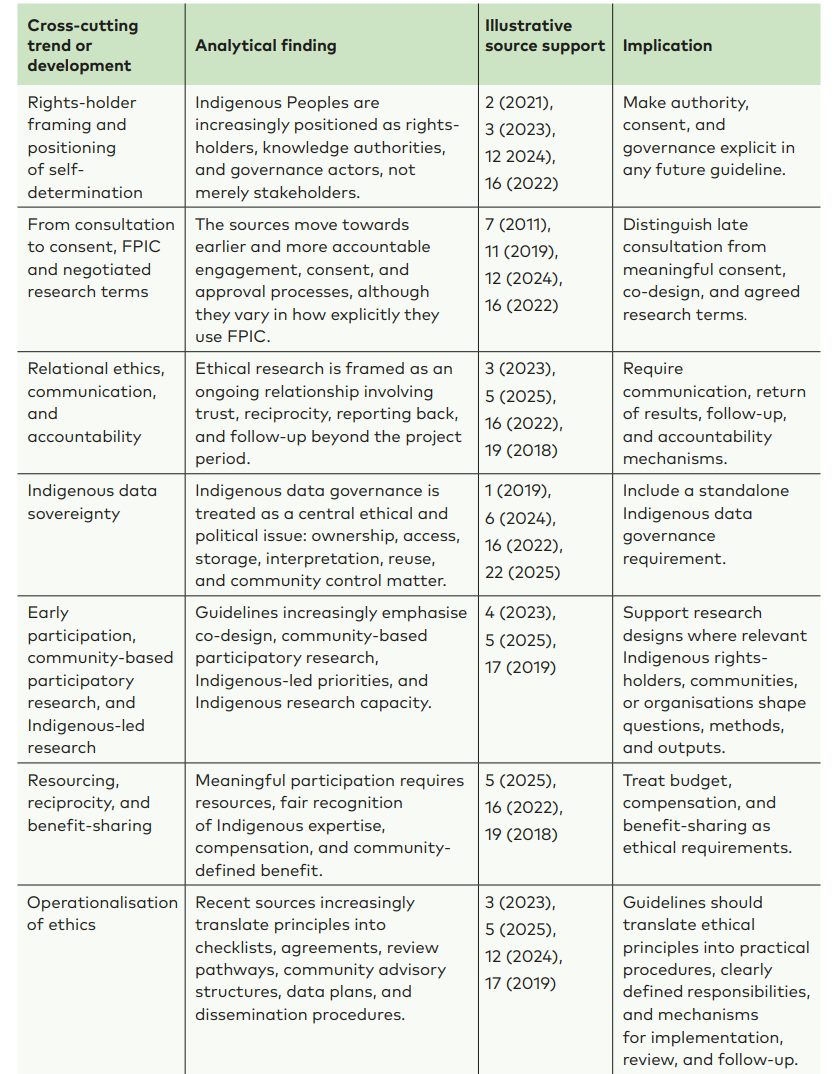
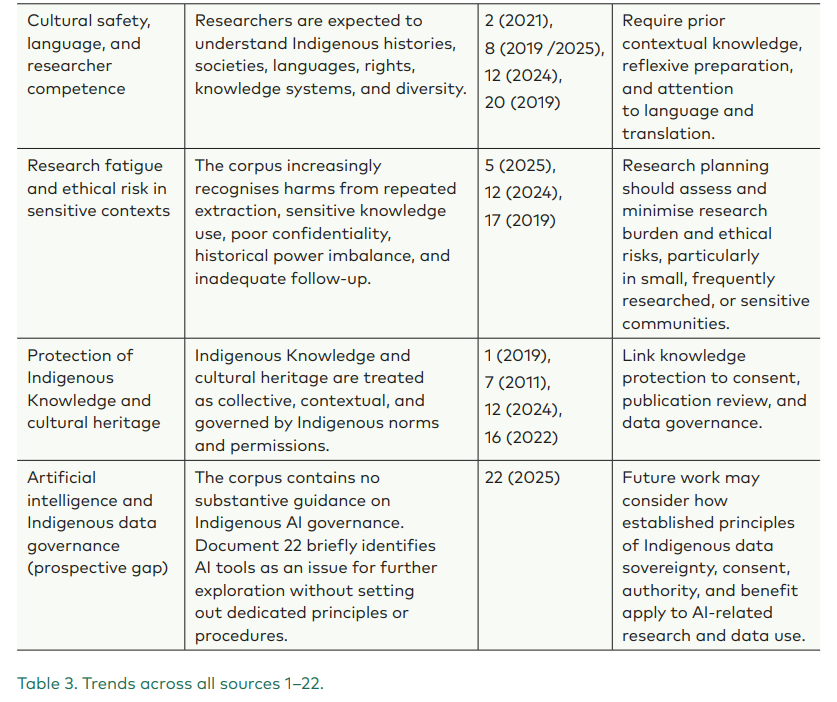
Taken together, these trends indicate a development towards more explicit Indigenous authority and governance and more practical mechanisms for implementing ethical commitments, while the variation across the corpus precludes a single model for all Indigenous and research contexts.
Artificial intelligence is a prospective gap rather than a trend within the reviewed corpus. Although document 22 briefly identifies AI tools as an issue for further exploration, no core source provides substantive guidance on Indigenous AI governance. Future work may therefore consider how established principles of Indigenous data sovereignty, consent, authority, and benefit apply to AI-related research and data use.