
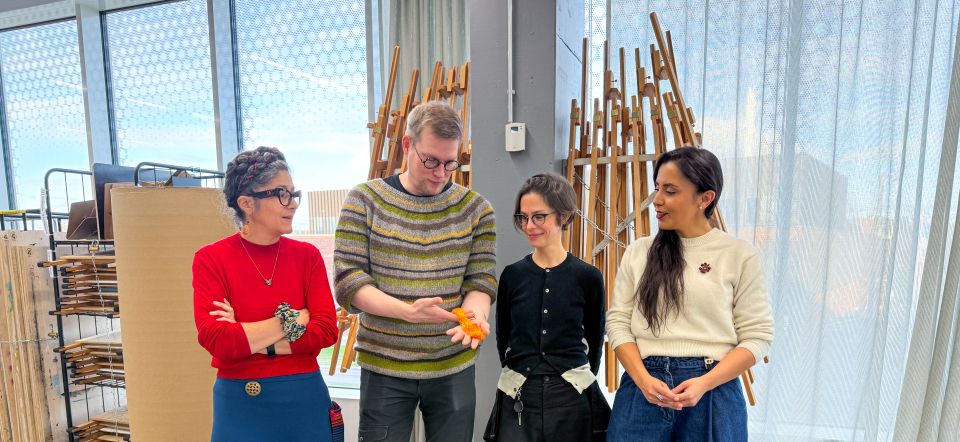
In the Amazonas grows a plant called Bixa Orellana, or achiote in Ecuador and urucum in Brazil. One November afternoon in Finland, the seed of this Amazonian plant was used to dye yarn a deep orange colour.
This dyeing process was the main part of a workshop by the research network Making Knowledge for Sustainable Transformations (MAST) which is funded through the NordForsk call Knowledge sharing and capacity building networks to strengthen Indigenous perspectives in research.
The MAST network consists of researchers and designers from Aalto University in Finland, Sámi University of Applied Sciences in Norway, Aalborg University in Denmark and the University of Umeå in Sweden. Together they explore how Indigenous knowledge connects with design and share practices through a set of three workshops.
“In the field of design, we work a lot with the idea that we produce knowledge through the things that we make, which might be a bit different from other fields. But we have found that we have a shared understanding of knowledge as Indigenous communities. The knowledge production is done not only through writing texts and publishing articles, but also for instance through creating a belt, by braiding something, or by working with the bones of reindeer, which we did at the first workshop. That is at the core of both the Indigenous understanding of the world, and the way designers produce knowledge,” says Julia Valle Noronha, Assistant Professor at Aalto University and the project leader for MAST.
Connecting the Global North and South
Valle Noronha is originally from Brazil and has colleagues in the network from Ecuador and Colombia. The second workshop therefore focused on facilitating dialogue between the Global South and the North.
“There has been a lot of efforts in the South to do this kind of research and work with Indigenous communities. So, we thought it would be valuable to learn from each other’s experiences and see how we could connect and advance Indigenous knowledge”, Valle Noronha says.
Crafting and sharing knowledge
The workshop at Aalto University in Finland lasted for two days and that both started with presentations by network participants and invited guest speakers from Peru and Colombia. After the presentations the participants dyed yarn and used the yarn to embroider a map of ideas, concepts and common values the network had agreed on during the first workshop which was held in Kautokeino, Norway earlier this year.


Integrated in the workshops are sharing circles where the participants together reflect on what they are learning.
“We have done a lot of discussing and talking. Whatever we are making, that activity alone is not sharing the knowledges we have. We come from different countries. We all come with different languages, different concepts and different needs. If we are not actually speaking to each other, showing each other, and explaining to each other, we would not be able to share any knowledge at all,” says Hanna-Máret Outakoski, Professor in Sámi language and Sámi didactics at the Sámi University of Applied Sciences.
Recognizing Indigenous knowledges
The workshop concluded with an open exhibition at Aalto University showcasing the final product, the embroidered concept map.
“On the map we mention the idea of healing the academia and different ways of sharing academic knowledge. Design and arts have gone through a lot of difficulties in validating the knowledge that we're doing.But we as designers in big universities have managed to validate our expertise perhaps much quicker than Indigenous knowledges. We can publish an artwork through an exhibition not only an academic journal, for example,” Julia Valle Noronha says.

Together the network hopes to put a bit of pressure on recognizing Indigenous knowledges as scientific knowledge.
“Making connections is the main point of the network. It gathers the scarce resources in Indigenous knowledge production. We have been discussing how we can go further after this network. What is role of the majority led universities and how can we help bring forward Indigenous voices. Another important question is; can we start building courses based on Indigenous knowledge and epistemes, and if so how? As a Sámi, I feel very privileged to be able to work in my own language and to have a Sámi university. But we are a small community, so working together with the bigger universities and Indigenous scholars, we can create better possibilities for other Indigenous communities to legitimized their knowledge production,” says Samuel Valkeapää, researcher at the Sámi University of Applied Sciences.
Read more about the MAST network and their workshops: MAST network | Making Knowledge for Sustainable Transformations

