

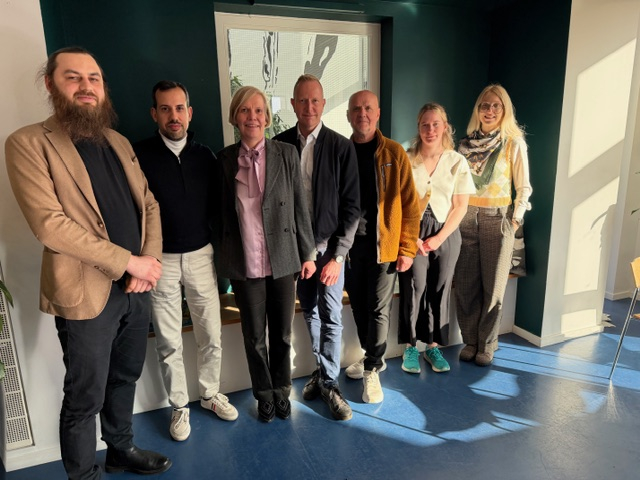
“Politically we live in very interesting times,” says Mari-Liis Jakobson, Professor of comparative politics at Tallinn University. She leads the project Political Inclusion in an Era of Radicalization (POLINERA).
“The political discourse has changed a lot. This era has been characterized by the rise of so-called populist right parties which typically have an anti-immigration agenda. They tend to be more authoritarian in their values, meaning that they prefer law-and-order type of solutions and expect that society ought to work based on uniform values. They also tend to claim that they are the ones representing the true people and they want to get mainstream politicians out of the office, come in and make the people's voice count,” she continues.

There have been many studies on how that resonates with ethnic majority voters' attitudes and who are voting for these parties. But not much is known about how migrant voters react to this era of right-wing surge in the Nordics and Baltics.
“On the one hand, they might feel left out, scapegoated, and antagonized because of the anti-immigrant agendas. On the other hand, we see a growing amount of populist radical right parties trying to appeal to some migrant voter groups. Some migrants come from countries where such authoritarian values are in high regards, and they might see those values as normal or reasonable. So, we became interested in seeing whether and how the success of these parties mobilises people with migration backgrounds,” says Jakobson.
Will the right-wing surge mobilise migrant voters?
The POLINERA project started with a dual hypothesis that things might go either way. The right-wing surge in the Nordics and Baltic might result in higher political integration and that more people with migrant background vote, or it might alienate them from politics completely.
“Earlier studies indicate that migrant voters usually tend to vote for social democratic parties on the left. At the same time, we see that in terms of attitudes, they are not necessarily on the left. POLINERA team member Johannes Bergh has already published a paper which shows that many immigrants to Norway are socioeconomically conservative and they might be supporting right-wing parties because of that,” Jakobson says.
“In Estonia, there is an expectation that Russian-speaking voters, most of whom have a migration background, are mainly mobilised by so-called ethnic and cultural issues, such as language rights. But our fieldwork during the local election campaign in 2025 indicates that people are much more concerned about local city environment issues. With these issues there might be much more interest overlap regardless of ethnic background or migration status. There is nothing like an average migrant voter. People come from different political cultures, have different interests, different worldviews. We want to understand this variety among migrant voters,” she continues.
Insight into how voting decisions are made
The POLINERA team is doing survey and registry data research in Norway and Estonia, as well as ethnographic fieldwork in the neighbourhoods Tingbjerg in Copenhagen, Denmark, Rosengård in Malmö, Sweden and Lasnamäe in Tallinn, Estonia. These neighbourhoods are characterised by being minority-majority districts with relatively low voter turnouts.
The researchers want to get qualitative insight into how people relate to politics, how voting decisions are made and what affects the decision. They also want to explore who campaigns in these districts, and how people living there respond to the campaigning.
“During the local election in Denmark last year there were initiatives to engage and inform people in Tingbjerg. The voter turnout increased from 33 to 47 per cent. We are exploring the initiatives to see who are more likely to respond to these kinds of initiatives, as well as the role of religious institutions and public spaces. We know from earlier studies that migrant voter turnout is lower because they lack information. They don't know when and how to vote, if the need to register or not and so on. So, spreading information is important,” she continues.
The research in Norway has already shown that the most passive group of migrants are labour migrants from Central and Eastern Europe. They have the right to vote in local elections but rarely use the opportunity.
“There seems to be a connection between the level of embeddedness in the society, integration, and participation in elections,” says Jakobson.
Need for more attention on political integration
Political integration is not discussed as much as for instance labour market integration. Therefore, Mari-Liis Jakobson hopes that POLINERA can draw attention to the relevance of the domain in a context where everything is increasingly political.
“I think it's important to pay attention to this field more globally, not just in the countries that we are studying, which are at the top of the democracy indexes in the world. Overall, we are witnessing something which is being called the liberal democratic backlash. It is important to understand how this is affecting the political inclusion of people with migration background. We also need to let go of the stereotype that migrants only vote for specific parties. If we see the diversity, it could empower political parties and empower different migrant groups so that they are more likely to get represented by representative parliamentary politics,” she says.
More about the project: Political Inclusion in an Era of Radicalization (POLINERA) | Tallinn University