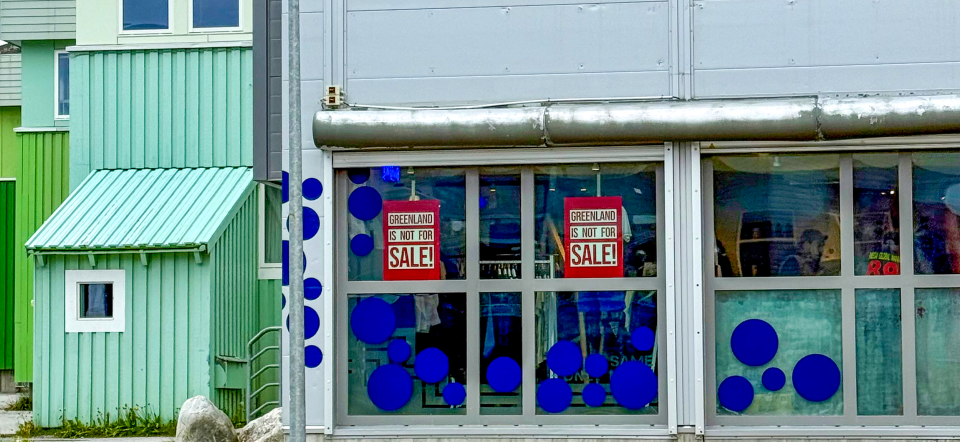
Manipulated videos, allegations of electoral fraud and fake posts on social media are examples of how disinformation is spread in Greenland.
Earlier this year, this prompted the Greenlandic self-government to launch the campaign "Pas på vores fællesskab – vær kritisk, når du søger information”. The aim was to equip the public to be critical of disinformation and influence operations, because, as the website states, “given the current threat picture, we must expect attempts by foreign actors to influence our public debate.”
Editorially controlled media inform the public of the truth
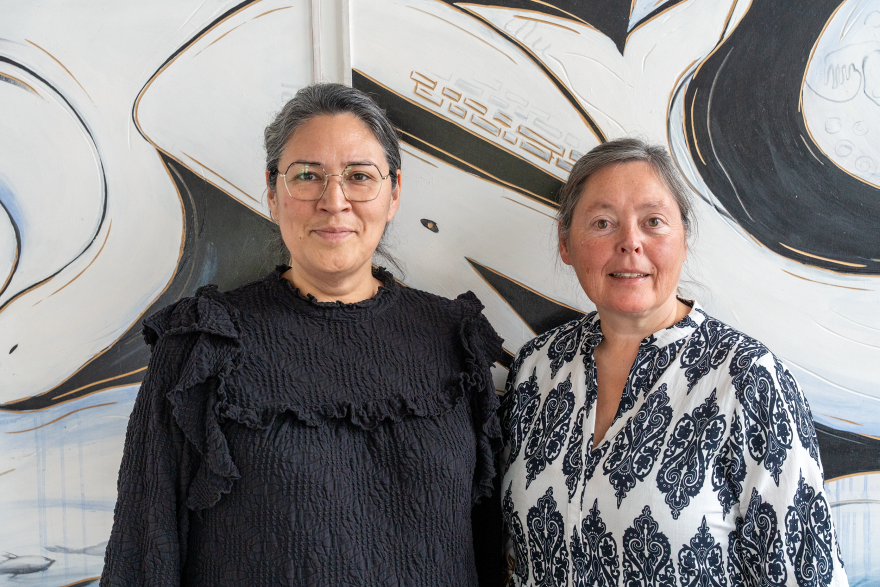
At Kalaallit Nunaata Radio (KNR), Greenland's public service radio and television station, they pay close attention to disinformation.
NordForsk's correspondent meet news editor Irene Jeppson and head of radio Aminnguaq Dahl Petrussen at KNR's newsroom in Nuuk. On the table are examples of stories with headlines such as "Manipulated videos abound on social media" and "Misinformation is spreading ahead of the election".
"We want to send the message to the public that they should trust the established media, because we fact-check, and if we receive a tip-off, we immediately set about investigating the matter thoroughly before we publish," says Irene Jeppson.
As in most parts of the world, social media is widespread throughout Greenland, and Facebook is by far the most widely used platform.
"Most people use Facebook to get socalled 'news', and this applies to both young and older people. We are bombarded with all sorts of things on social media, and Facebook has no editorial team unlike editorially controlled media. Nobody fact-checks social media. We need the press to sort out what is right and wrong, because it is our duty to tell the true story and to be trustworthy," says Irene Jeppson.
A small community that is good at spotting false information
A year ago, a fake video was circulating on social media featuring the then chair of the Greenlandic self-government, Múte B. Egede, who was reportedly being interviewed by an American journalist. The video quickly turned out to be fake.
There have also been several fake TikTok profiles pretending to be the Greenlandic government and calling themselves Naalakkersuisut, just as there are fake profiles featuring the current chairman of the self-government Jens Frederik Nielsen. A few days before this interview took place, there was also a fake TikTok profile pretending to be a Greenlandic politician which was spreading hateful views about Danes.
"I think we're good at spotting these types of stories, and that's perhaps the advantage of being a small community. When you live here, you can tell straight away whether something is true or false, because there are so few of us that people quickly spot it and warn others. It’s not that easy to fool us, because we don’t swallow everything hook, line and sinker,” says head of radio Aminnguaq Dahl Petrussen.
Attempts at American influence
The intense focus in recent years on the conflict between the United States, Greenland and Denmark has put enormous pressure on the editorial team at KNR, say Irene Jeppson and Aminnguaq Dahl Petrussen.
According to Danish intelligence, the United States has actively spread disinformation and carried out influence operations in Greenland. KNR has also had a visit from Denmark's national security and intelligence service (PET) at the newsroom in Nuuk.
"They came to make us aware that we might face pressure from outside. They asked us to keep a close watch and to inform them if we notice anything suspicious."
Journalists are in short supply in Greenland, even though it is possible to study journalism at the University of Iisimatusarfik.
"We want to do critical and investigative journalism, but the reality is that we are short-staffed. We must prioritise, so often we end up doing day-to-day journalism. Even so, I think we’ve done well to cope with this whole difficult period, as we’ve been under enormous external pressure. Despite this, we've run exclusive stories that have reached most of the world. We've never experienced that before," says Irene Jeppson.
You must also bear in mind that, although we are journalists and a media organisation, we are also part of a population that one of the world's absolute largest superpowers planned to annex by military force.
“Whilst we were supposed to be journalists, we were afraid and worried. We didn't know what to do, because it was a situation we had never experienced before," says Aminnguaq Dahl Petrussen.
At one point, there was a power cut in Nuuk, and Irene Jeppson went into the newsroom in the middle of the night to broadcast radio bulletins.
"We informed the public that it was simply a power cut. It was not because we were under military attack, as some feared. This shows that the pressure we have been under has been extreme," says Irene Jeppson and Aminnguaq Dahl Petrussen adds:
"When the threats from the United States were at their height, we held morning meetings in the radio newsroom where we just sat and cried a little. Then we listened to some quiet, relaxing music. We were human beings too, and we had to be allowed to feel afraid, whilst at the same time producing journalistic content and getting information out to the public.”
Trust in Greenland
How can we make our free, Nordic societies more resilient to disinformation and external influence?
Najaaraq Demant-Poort from the University of Greenland is a PhD student and researcher specialising in trust within Greenlandic society. She explains that, in the Nordic region, there is a great deal of research into the significance of trust in everything from the economy to public health to the political system, as well as into the role of trust within organisations and in group collaboration.
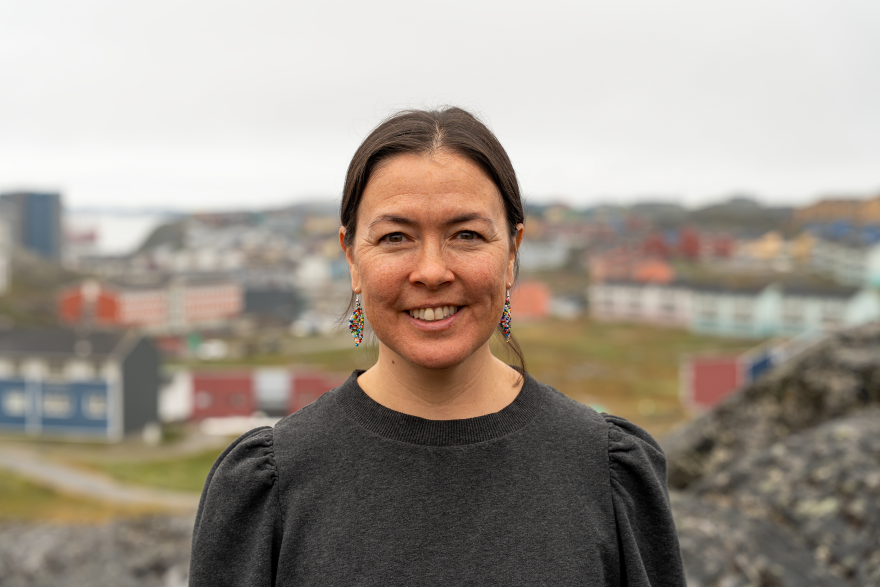
"Trust has become a normative concept and is particularly referred to in the Nordic countries as a value we strive for. Politicians in the Nordic Region also use it a lot to highlight the positive qualities of the Nordic societies, and it is this political version of trust as a social value that has been most dominant in recent years."
Najaaraq Demant-Poort also emphasises that the Nordic focus on trust as a social value has had a knock-on effect on both the Organisation for Economic Co-operation and Development (OECD), which now has an entire research programme dedicated to trust, and in the UN's World Happiness Reports, where trust has also come to play a major role.
"Here we are in Greenland, a former colony, and through the process of colonisation we have inherited the welfare institutions that leading academic research often associates with high levels of trust. The question is, has that trust followed the Nordic societal model?” asks Najaaraq Demant-Poort.
She has studied how trust is built in everyday life with each other. Two aspects are particularly interesting in this context: the post-colonial legacy and the closeness of the micro-community.
Greenlandic respondents were asked about social trust, which relates to whether people believe that other people in general can be trusted.
"This is what many refer to as the Nordic gold. This is the version of trust that is talked about in the Nordic Council of Ministers, and which we call social trust. The responses show that Greenland has a completely different pattern of trust than in Denmark. I am not concluding from this that trust is generally lower in Greenland, but when asked the same questions, Greenlandic respondents answer differently.”
Whilst 70 to 80 per cent of the Danish respondents say they have a high level of trust in people in general, the figure for Greenlandic respondents is down to around 50 to 60 per cent.
"It shows that there is a very significant difference between our countries. At the same time, the data also shows that people in Greenland have a high level of trust in those closest to them, i.e. people with whom they have a close relationship. And that they have a high level of trust in institutions," she says and adds:
"We support the welfare institutions, even though we may be critical of them, but this does not fundamentally undermine our trust in them. A few years ago, the Greenlandic Constitutional Commission published a draft of a new social model, and it did not alter the fundamental institutional framework in Greenland. This shows that we still value the 'Nordic institutional model'," says Najaaraq Demant-Poort.
Distrust rather than trust can be a safeguard against disinformation
In many contexts, trust is mentioned as the factor that makes our societies resilient to disinformation and influence operations. But a high level of trust is not necessarily an advantage. According to Najaaraq Demant-Poort, trust and distrust can coexist.
“Trust is not a safeguard against external influences, because you could just as easily argue that too much trust within a group can easily lead to people closing themselves off and refusing to accept information from outside. In some contexts, a certain degree of mistrust can actually be beneficial, as it can act as a protective factor if it is justified. We may well have a tendency to become a little fixated on the idea that the greater the level of trust in our society, the better, but that is not necessarily the case," she says.
Reportages from Greenland
Greenland has about 55,000 inhabitants and is located on the North American continent, but geopolitically, the country is part of Europe. Greenland has self-government within the Kingdom of Denmark.
NordForsk went on a reporting trip to the capital Nuuk.
This is the second part of the series.
You can read the first part here: Greenland wants to strengthen its research environment, and the Nordic region is an important partner